The benefits of deadlifts go far beyond building bigger muscles. This compound strength-training exercise works several major muscle groups simultaneously, helping you develop strength, improve movement, and perform everyday activities more comfortably.
Although many people associate deadlifts with powerlifters and bodybuilders, beginners and recreational exercisers can also benefit from learning the movement. In fact, you don’t need extremely heavy weights to make progress.
When you use proper technique and suitable resistance, deadlifts can strengthen your legs, hips, back, and core. In addition, regular resistance training supports bone health and helps maintain physical function as you age.
Whether you’re starting a fitness routine or improving your current workouts, understanding how deadlifts work can help you train more effectively.
What Are the Benefits of Deadlifts?
Deadlifts are compound resistance exercises that involve lifting a weight from the floor or another starting position by extending your hips and knees.
Unlike isolation exercises, which primarily target individual muscles, deadlifts challenge several muscle groups together.
As a result, they provide an efficient way to develop functional strength.
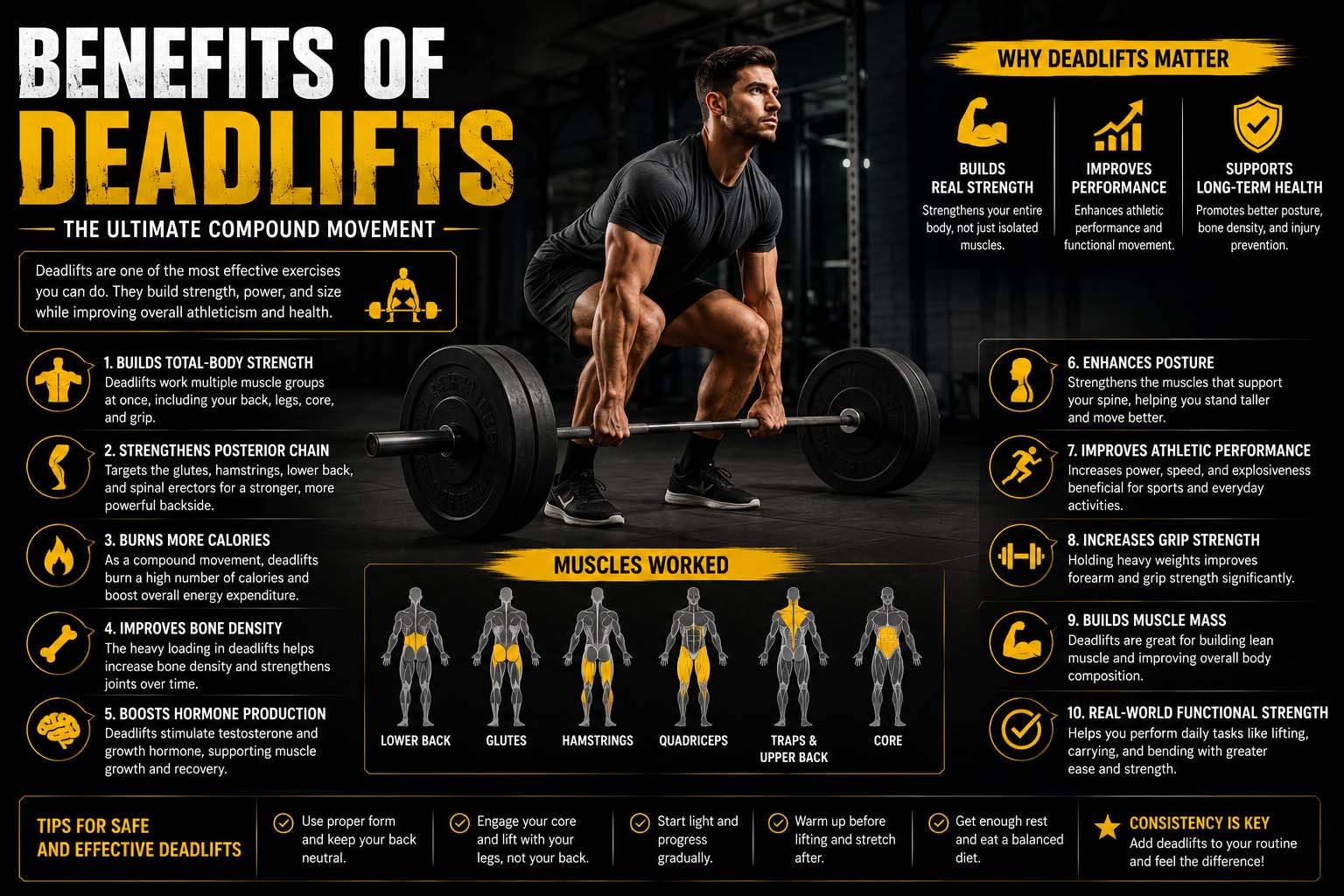
Here are 10 important benefits:
| Benefit | How It Helps |
|---|---|
| Full-body strength | Strengthens multiple major muscle groups |
| Functional fitness | Improves strength for everyday lifting tasks |
| Posture support | Develops muscles involved in maintaining body position |
| Core stability | Challenges muscles that stabilize the trunk |
| Bone health | Provides mechanical loading that supports bone strength |
| Energy expenditure | Adds physical activity to a weight-management routine |
| Coordination | Develops control across several joints |
| Grip strength | Challenges the hands and forearms |
| Muscle development | Supports growth when paired with progressive training |
| Athletic performance | Develops hip and leg strength for physical activities |
However, results depend on technique, training consistency, recovery, and individual fitness levels.
1. Full-Body Strength Benefits of Deadlifts
One of the biggest advantages of deadlifts is their ability to strengthen several major muscle groups during one exercise.
For example, conventional deadlifts primarily challenge the hips, legs, and back while requiring the core to stabilize the trunk.
Major muscles involved include:
- Gluteus maximus
- Hamstrings
- Quadriceps
- Spinal erectors
- Trapezius
- Upper-back muscles
- Abdominal muscles
- Forearm and grip muscles
Although these muscles contribute differently throughout the movement, they work together to lift and control the weight.
Therefore, deadlifts can help make strength workouts more efficient.
In addition, people exploring other resistance-training methods may find the benefits of a weighted vest useful when planning a balanced fitness routine.
2. Functional Strength Benefits for Everyday Life
Functional strength refers to your ability to perform practical movements comfortably and efficiently.
Because deadlifts train the hip-hinge movement, they can help you develop strength for tasks that involve lifting and carrying objects.
For example, everyday activities include:
- Picking up grocery bags
- Lifting storage boxes
- Carrying household items
- Gardening
- Moving lightweight furniture
- Handling equipment
- Performing household chores
However, gym strength doesn’t automatically guarantee safe lifting technique in every situation.
Therefore, practice keeping objects close to your body, controlling your movements, and choosing manageable loads.
Over time, improved strength may make routine physical tasks feel less demanding.
3. Deadlift Benefits for Posture and Back Strength
Many people spend long hours sitting at desks or looking at screens.
As a result, they may experience muscle stiffness, reduced movement, or discomfort.
Deadlifts strengthen several muscles involved in maintaining trunk position, including:
- Spinal erectors
- Upper-back muscles
- Glutes
- Abdominal muscles
- Hip extensors
For example, stronger back and hip muscles can improve your ability to maintain a stable position while lifting.
However, deadlifts alone cannot correct every posture problem or guarantee relief from back pain.
In addition, comfortable posture depends on mobility, daily habits, movement variety, and individual physical conditions.
Therefore, combine resistance training with regular movement and appropriate mobility exercises.
4. Core Strength and Stability Benefits of Deadlifts
You don’t need to rely entirely on crunches to challenge your abdominal muscles.
During a deadlift, your core helps stabilize your trunk while your hips and legs generate lifting force.
In particular, the exercise challenges:
- Abdominal muscles
- Obliques
- Deep trunk stabilizers
- Spinal erectors
Because these muscles work together, deadlifts provide a useful form of core training.
For example, maintaining a stable trunk while lifting a moderate weight develops coordination between your core and lower body.
However, the goal isn’t to hold your breath throughout the entire exercise.
Instead, learn appropriate breathing and bracing techniques from a qualified trainer, especially when progressing to heavier loads.
5. Bone Health Benefits of Deadlifts
Resistance exercise places mechanical stress on muscles and bones.
Over time, appropriate training can help maintain or improve bone strength, depending on age, training intensity, and individual health.
Deadlifts are one way to include resistance exercise in a bone-supporting fitness routine.
However, bone health also depends on several factors, including:
- Adequate calcium intake
- Vitamin D status
- Balanced nutrition
- Regular physical activity
- Age and hormonal factors
- Overall health
For example, a well-designed strength program may combine deadlifts with other lower-body exercises.
In addition, readers interested in bone-supporting nutrients can explore the benefits of d3 and k2.
Nevertheless, supplements aren’t necessary for everyone, and they cannot replace a balanced diet or appropriate medical care.
People with osteoporosis or a history of fractures should seek individualized exercise guidance before attempting heavy lifts.
6. Deadlift Benefits for Weight Management
Deadlifts recruit several large muscle groups, making them a demanding resistance exercise.
As a result, they contribute to the energy your body uses during a workout.
However, deadlifts alone won’t guarantee weight loss.
Instead, sustainable weight management depends on overall activity, nutrition, sleep, and long-term habits.
Deadlifts may support a fitness plan by helping you:
- Maintain or develop muscle
- Improve training capacity
- Increase overall physical activity
- Build strength during weight management
- Develop a consistent exercise routine
For example, someone following a balanced resistance-training program may use deadlifts alongside walking, cycling, or other cardiovascular activities.
In addition, tracking body weight consistently can help some people monitor long-term changes.
Our guide on the best time to weigh yourself explains how consistent measurement habits can improve progress tracking.
7. Balance and Coordination Benefits of Deadlifts
Deadlifts require your hips, knees, trunk, and upper body to work together.
Therefore, learning the movement can improve your ability to coordinate several joints during a controlled lifting task.
Important movement skills include:
- Hip-hinge control
- Trunk stability
- Weight distribution
- Grip coordination
- Controlled lifting and lowering
For example, beginners often learn to keep the weight close to their legs while maintaining a stable trunk.
As their technique improves, they may become more confident performing similar movements.
However, deadlifts aren’t a substitute for dedicated balance exercises.
For older adults, a complete fitness program should also include activities that specifically challenge balance and mobility.
8. Grip Strength Benefits of Deadlifts
Your hands and forearms play an important role during deadlifts.
Because you must hold the bar throughout each repetition, the exercise challenges your grip.
For example, a conventional double-overhand grip can help develop holding strength as you gradually increase resistance.
Stronger grip muscles may support activities such as:
- Carrying shopping bags
- Holding exercise equipment
- Performing pulling exercises
- Carrying household objects
However, grip strength can become a limiting factor before your legs or hips reach their full training capacity.
Therefore, use appropriate loads and prioritize controlled technique.
9. Muscle Growth Benefits of Deadlifts
Deadlifts provide resistance to several major muscle groups.
When combined with progressive training, adequate nutrition, and recovery, they can contribute to muscle development.
In particular, the exercise challenges the glutes, hamstrings, and spinal erectors.
However, muscle growth depends on more than choosing one exercise.
Important factors include:
- Appropriate training volume
- Gradual progression
- Sufficient recovery
- Adequate protein intake
- Consistent workouts
For example, combining deadlifts with squats, rows, and other exercises can provide more complete muscular development.
Therefore, use deadlifts as part of a balanced strength program rather than relying on them alone.
10. Athletic Performance Benefits of Deadlifts
Athletes often use deadlift variations to develop hip and leg strength.
Because these muscles contribute to many sporting movements, stronger hip extensors can support overall physical performance.
For example, deadlift training may complement activities that involve:
- Running
- Jumping
- Sprinting
- Lifting
- Carrying
- Changing body position
However, improved deadlift strength doesn’t automatically translate into better performance in every sport.
Instead, athletes need sport-specific training, conditioning, mobility, and recovery.
Therefore, coaches typically include deadlifts alongside other exercises that match an athlete’s goals.
Benefits of Deadlifts for Men
The benefits of deadlifts for men extend beyond building larger muscles.
Although strength goals vary, deadlifts can support several aspects of physical fitness.
Greater total-body strength: Because deadlifts challenge multiple muscle groups, they can help men develop strength throughout the hips, legs, and back.
Muscle development: When paired with suitable training volume and nutrition, deadlifts contribute to muscle growth.
Athletic conditioning: Stronger hips and legs can support training for various sports and physical activities.
Functional fitness: In addition, improved lifting strength may make everyday tasks more manageable.
However, men don’t need to lift extremely heavy weights to benefit.
Instead, progressive training and consistent technique provide a safer foundation for long-term improvement.
Benefits of Deadlifts for Women
The benefits of deadlifts for women are similar to those for men.
In fact, resistance training provides valuable strength and functional benefits regardless of sex.
Improved strength: Deadlifts strengthen the lower body and challenge the core.
Glute and leg development: For example, the movement trains the glutes, hamstrings, and quadriceps.
Bone health: In addition, appropriate resistance training can support healthy bones throughout adulthood.
Confidence: Learning new lifting skills may improve confidence during workouts.
Everyday movement: As strength improves, carrying bags and lifting household objects may become easier.
However, women don’t automatically develop excessive muscle size from resistance training.
Muscle growth depends on training intensity, nutrition, genetics, and recovery.
Therefore, women can choose deadlift variations and training loads that match their individual goals.
Benefits of Sumo Deadlifts
The benefits of sumo deadlifts make this variation a useful alternative to conventional deadlifts.
A sumo deadlift typically involves a wider stance, with the hands positioned inside the legs.
As a result, the movement changes joint positions and how different muscles contribute to the lift.
Sumo Deadlift Benefits for Torso Position
Sumo deadlifts often allow a more upright torso than conventional deadlifts.
For example, some lifters find this position more comfortable because of their individual proportions.
However, a more upright torso doesn’t guarantee lower back safety or eliminate spinal loading.
Therefore, choose a stance that allows controlled movement without discomfort.
Quadriceps Activation in Sumo Deadlifts
Compared with conventional deadlifts, sumo deadlifts can place different demands on the knee and hip extensors.
In particular, the wider stance and altered joint angles may increase the relative contribution of the quadriceps during parts of the movement.
However, both variations still train the glutes, legs, and back.
Hip and Leg Positioning for Sumo Deadlifts
Some lifters prefer the wider stance because it suits their body proportions.
For example, hip anatomy and mobility can influence which deadlift variation feels more natural.
Nevertheless, a wide stance isn’t automatically better for everyone.
Instead, experiment with manageable loads and seek coaching if you’re uncertain about your technique.
Conventional vs. Sumo Deadlift Benefits
| Feature | Conventional Deadlift | Sumo Deadlift |
|---|---|---|
| Foot Position | Relatively narrow | Wide |
| Hand Position | Outside the legs | Inside the legs |
| Torso Angle | Often more forward | Often more upright |
| Knee Position | Less knee bend at setup | Often greater knee bend |
| Hip Position | Relatively higher | Often lower |
| Muscle Emphasis | Strong hip and posterior-chain demand | Strong hip and leg demand |
| Best Choice | Depends on mobility and goals | Depends on mobility and goals |
Neither variation is universally superior.
Therefore, select the movement that suits your anatomy, training objectives, and comfort.
How to Perform Deadlifts Safely
Learning proper technique helps you develop strength while managing injury risk.
Although individual lifting styles vary, beginners can follow these general steps.
- Stand with your feet approximately hip-width apart and the bar over your midfoot.
- Hinge at your hips and bend your knees enough to reach the bar.
- Grip the bar just outside your legs.
- Brace your trunk and maintain a comfortable, stable spinal position.
- Keep the bar close as you push through your feet and extend your hips and knees.
- Stand tall without leaning excessively backward.
- Lower the bar with control by hinging at your hips and bending your knees.
For example, beginners may find it easier to practice the movement with a light kettlebell or an elevated bar.
However, avoid forcing yourself into a setup position that causes pain.
Instead, adjust the equipment or consult a qualified trainer.
The American College of Sports Medicine provides professional resources related to exercise science, physical activity, and resistance training.
Common Deadlift Mistakes to Avoid
Proper technique can help improve exercise quality and reduce unnecessary strain.
However, several common mistakes can interfere with safe progression.
Rounding the lower back excessively: Aim for a stable spinal position that you can maintain throughout the lift. However, natural spinal movement varies between individuals.
Lifting too heavy too soon: First, master the movement with manageable resistance. Then, increase the load gradually as your technique and strength improve.
Pulling mainly with the arms: Your hips and legs should generate most of the lifting force. Meanwhile, your arms primarily hold the weight.
Letting the bar drift away: Keep the bar relatively close to your body. As a result, you can maintain better control over the load.
Skipping warm-ups: Before lifting heavy weights, perform light movement and progressively heavier preparation sets.
Rushing repetitions: Instead, lift and lower the weight with control.
Ignoring pain: If an exercise causes sharp or worsening pain, stop and seek appropriate guidance rather than forcing additional repetitions.
Who Should Be Careful With Deadlifts?
Deadlifts can suit many healthy adults when they use appropriate technique and resistance.
However, certain health conditions require additional precautions.
Speak with a healthcare professional or appropriately qualified exercise specialist before attempting heavy deadlifts if you have:
- A recent back injury
- Severe osteoporosis
- Uncontrolled high blood pressure
- Recent surgery
- Persistent joint pain
- A condition that affects balance or movement
- Pregnancy-related lifting concerns
For example, someone recovering from a back injury may need a modified exercise program.
Similarly, people with osteoporosis may require adjustments to spinal positioning, resistance, and exercise selection.
Therefore, individual guidance is more useful than applying the same lifting rules to everyone.
Tips to Maximize Deadlift Benefits
Healthy habits support strength development and recovery.
For example, consider these practical strategies:
- Warm up for 5–10 minutes.
- Learn proper technique before adding significant weight.
- Increase resistance gradually.
- Allow enough recovery between demanding sessions.
- Eat sufficient protein.
- Stay hydrated.
- Sleep consistently.
- Include other resistance exercises.
- Combine strength training with cardiovascular activity.
In addition, choose a workout schedule you can maintain.
Our guide to the best time to workout explains how to build an exercise routine around your daily schedule.
Likewise, protein intake can support muscle recovery and growth.
If you’re considering supplements, our best protein powder guide can help you compare options based on your goals and dietary preferences.
However, protein supplements aren’t essential when your regular diet already meets your nutritional needs.
Overall, consistent training and recovery matter more than lifting the heaviest possible weight every session.
Common Myths About Deadlifts
Several misconceptions discourage people from trying deadlifts.
However, understanding the facts can help you make better training decisions.
Myth: Deadlifts are always bad for your back.
Deadlifts aren’t automatically harmful to the back. In fact, appropriately programmed resistance training can strengthen the muscles involved in lifting.
However, technique, load selection, individual health, and recovery influence injury risk.
Myth: Only athletes should perform deadlifts.
Beginners and recreational exercisers can also benefit from deadlift variations.
For example, a beginner might start with a light kettlebell deadlift.
Myth: Deadlifts make women excessively muscular.
Resistance training supports strength and muscle development. However, substantial muscle growth generally requires sustained training and appropriate nutrition.
Myth: You must lift extremely heavy weights.
Light and moderate resistance can provide meaningful training benefits.
Therefore, choose a weight that allows controlled repetitions and gradual progression.
Frequently Asked Questions About Deadlift Benefits
How Often Should Beginners Do Deadlifts?
Many beginners can include a deadlift variation once or twice weekly, depending on their program and recovery.
However, the ideal frequency depends on training experience, exercise intensity, and overall workload.
Are Deadlifts Good for Weight Loss?
Deadlifts can contribute to a weight-management program by increasing physical activity and supporting muscle maintenance.
However, lasting weight changes depend on overall nutrition, activity, and lifestyle habits.
Can Beginners Perform Deadlifts?
Yes. Beginners can learn deadlifts using light weights, kettlebells, or an elevated bar.
For example, practicing the hip hinge without weights can help develop movement control before adding resistance.
Do Deadlifts Improve Posture?
Deadlifts strengthen muscles that help stabilize the trunk and support lifting movements.
However, they don’t guarantee improved posture or eliminate discomfort.
Therefore, combine strength training with regular movement and suitable mobility exercises.
Are Deadlifts Enough for a Complete Workout?
No. Deadlifts are effective, but a balanced fitness program should include other strength exercises, cardiovascular activity, and mobility work.
For example, squats, rows, presses, and walking can complement deadlift training.
Should I Choose Conventional or Sumo Deadlifts?
Choose the variation that suits your mobility, body proportions, and training goals.
Although both movements develop strength, their joint positions and muscle demands differ.
Therefore, prioritize comfort and controlled technique rather than assuming one variation is better.
Can Deadlifts Help Older Adults?
Appropriate resistance training can help older adults maintain strength and physical function.
However, exercise selection and intensity should match individual ability and health conditions.
For example, some older adults may benefit from light kettlebell deadlifts or modified hip-hinge exercises.
Key Takeaways: Benefits of Deadlifts
The benefits of deadlifts extend beyond lifting heavier weights. This compound exercise develops strength throughout the hips, legs, back, and core while supporting practical movement skills.
In addition, regular resistance training can contribute to muscle development, bone health, and long-term physical function.
Whether you prefer conventional or sumo deadlifts, the most effective approach involves proper technique, manageable resistance, and gradual progression.
However, remember that deadlifts are only one part of a balanced fitness program.
Therefore, combine them with other strength exercises, regular physical activity, adequate nutrition, and sufficient recovery.
With consistent practice, deadlifts can become a valuable exercise for improving strength, movement confidence, and everyday fitness.